








SHACMAN Automobile 20m³ Fuel Tanker Truck: A Practical Fuel Tank Truck Guide for Bulk Fuel Transport
Choosing the wrong tank truck can lead to leaks, unstable handling, slow unloading, and wasted money. That problem grows fast when routes are long and delivery schedules are tight. The better solution is a purpose-built fuel tanker truck with the right tank system, chassis, and export support.
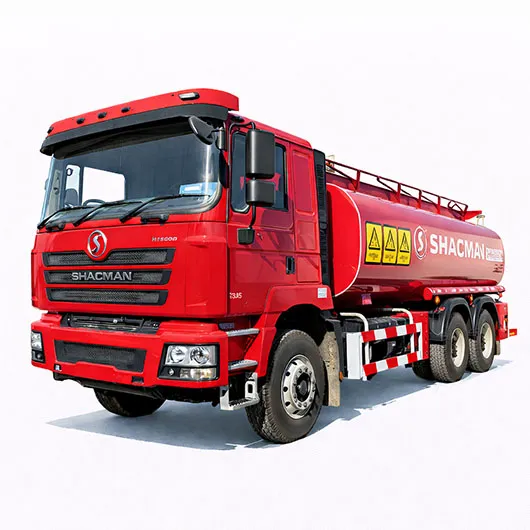
A SHACMAN Automobile 20m³ Fuel Tanker Truck is a heavy-duty tanker built for safe, efficient fuel distribution. On All Lifecycle’s product page, it is positioned for long-distance fuel logistics, with optional Weichai or Cummins power, a 20 m³ tank, optional compartment design, aluminum alloy fittings, and an integrated dispensing system for stable fuel transfer.
If you buy trucks for projects, depots, distributors, or fleet operations, you already know this: the truck itself is only half the decision. The other half is matching the configuration to your routes, fuel type, regulations, and service plan. That is where All Lifecycle tries to stand out. The company presents itself as a China-based export-oriented truck supplier working with brands such as Shacman and Sinotruk, while also offering new and high-quality used trucks, customization, export handling, and after-sales support for overseas B2B buyers.
Why is the SHACMAN 20m³ fuel tanker truck attractive to overseas buyers?
The biggest reason is fit. A good fuel tank truck must carry liquid cargo safely, stay balanced on real roads, and support efficient unloading at the destination. The product page describes this model as a purpose-built fuel transportation solution for safe, efficient, and precise delivery of petroleum products, especially in long-distance distribution and bulk fuel logistics.
I also think buyers like clear, practical configurations. This shacman model is not presented as a flashy concept. It is shown as a working automobile for real fleet tasks: stable handling, accurate dispensing, and corrosion-resistant tank components. That is exactly what importers and project buyers usually care about most.
For B2B customers, flexibility matters too. All Lifecycle states that it supplies both new trucks and high-quality used trucks for global markets, which helps buyers combine budget control with fleet planning. For a distributor or contractor, that can mean pairing one new tanker with one used sinotruk howo support truck or adding a refurbished dump truck to the same order.
What makes a 20m³ tanker different from smaller tanker trucks?
Capacity changes the business case. A 20m³ tanker gives buyers a stronger balance between payload and route efficiency than many smaller tanker trucks. On the product page, the tank capacity is clearly stated as 20 m³, which equals about 20cbm or 20 cubic meters, and that directly supports higher-volume fuel distribution work.
In practical terms, more capacity can reduce trip frequency. That matters for fleet operators serving depots, fuel stations, industrial customers, or project sites. A bigger tank truck can move more diesel or other refined products per trip, which can lower labor cost and improve route economics when the roads and regulations allow it. This is especially useful in medium- and long-distance fuel delivery scenarios, which the page specifically highlights.
Of course, bigger is not always better. The right size depends on road width, turning limits, daily delivery pattern, and unloading conditions. But for many professional buyers, a shacman 20m³ model hits the sweet spot between capacity and workable mobility.
Why does the 6×4 SHACMAN truck layout matter for fuel transport?
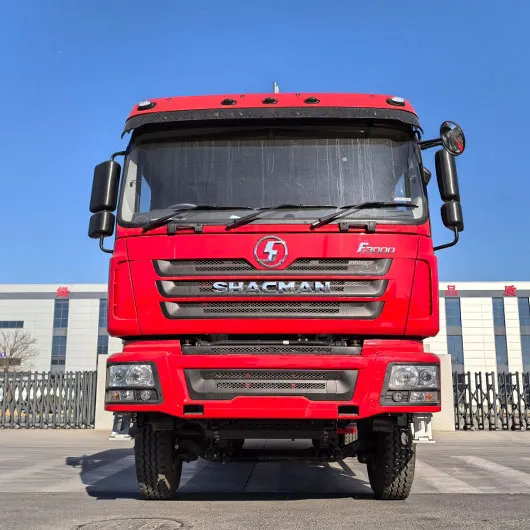
The product page lists drive type as “as configured,” but the market commonly pairs this kind of model with a 6×4 heavy chassis, and your keyword direction clearly reflects that buying logic. For fuel hauling, a 6×4 layout is widely valued because it gives good balance between load support, stability, and route practicality. Combined with 10 wheels, it usually suits serious road transport without the complexity of the largest configurations.
A liquid load behaves differently from dry cargo. Fuel moves inside the tank under braking, turning, and uneven surfaces. That is why the truck’s axle logic, suspension behavior, and mounting design matter so much. All Lifecycle’s page specifically says the truck has a well-balanced chassis and tanker layout, plus an optimized tanker structure and mounting design to improve stability and safety when carrying liquid fuel.
For many buyers, that makes a shacman truck like this more practical than forcing a smaller 4×2 into work it was not built for. A 4×2 might suit lighter regional service, but a serious fuel tanker truck for bulk delivery often needs stronger support. At the same time, some fleets may later scale into 8×4 or semi trailer tanker systems when route density and volume grow.
What tank structure and fuel system details should buyers check first?
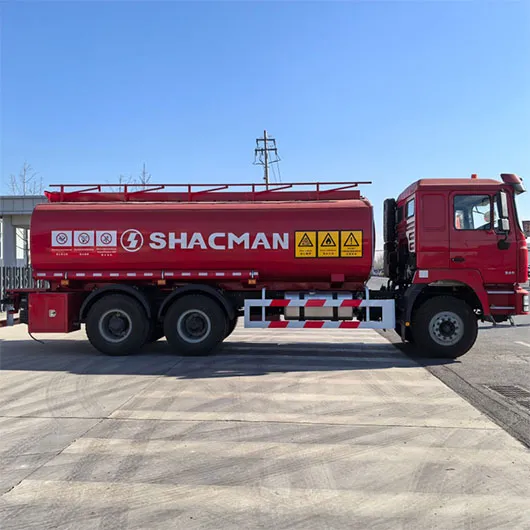
This is where a professional tanker proves its value. All Lifecycle highlights several key system details: optional compartmentalized tank design, 20-inch aluminum alloy manhole covers, aluminum alloy subsea valves, fuel nozzles, flow meters, and a copper gear oil pump. Those are not decorative specs. They directly shape sealing reliability, corrosion resistance, dispensing accuracy, and long-term service performance.
The optional compartment design is especially useful. It lets operators transport multiple fuel types at once. For example, one buyer may need diesel in one section and another refined product in another. That improves route flexibility and helps the same tank truck serve mixed delivery needs.
I always tell buyers to study what happens inside the tank, not just outside it. Tank segmentation, sealing design, manhole access, and valve quality all affect safety and operating efficiency. If you move oil fuel, gasoline, or other petroleum products daily, those details are where maintenance cost and delivery accuracy are won or lost.
Key tank and fuel system items
- Optional compartmentalized tank structure
- 20-inch aluminum alloy manhole covers
- Aluminum alloy subsea valve design
- Integrated nozzle and flow meter
- Copper gear oil pump
- Multi-point sealing for leakage prevention
Is the SHACMAN 20m³ fuel tanker truck only for diesel and gasoline delivery?
No. The page frames it around petroleum products, bulk energy delivery, and refined oils. It specifically mentions gasoline, diesel, and other refined oils in its application section, which shows that the truck is aimed at broader fuel transport, not one narrow liquid only.
That means the truck can fit several roles. It can work as an oil tanker truck for depot-to-station supply. It can act as a refueling truck for equipment fleets. It can support industrial sites that need controlled fuel transfer. In some operations, it may even function almost like a compact fuel truck alternative to larger tanker trucks or trailer systems.
I would not market it as a water truck or any unrelated service body, because this page is clearly written for fuel logistics. But I would absolutely highlight that one properly configured fuel tank truck can help operators refuel stations, machinery, project vehicles, and regional supply points more efficiently.
How does this SHACMAN tanker compare with other heavy truck categories?
This question matters because B2B buyers rarely buy one truck type in isolation. A distributor handling tanker trucks may also stock a cargo truck, dump truck, or crane truck. A contractor may need one fuel tank truck, one mixer truck, and one support tipper in the same quarter. All Lifecycle’s wider site structure reflects exactly that multi-category buying logic.
Compared with a cargo vehicle, this model is purpose-built for liquid handling. Compared with a dump truck, it focuses on sealed transport and precise discharge, not tipping. Compared with a shacman f3000 or sinotruk howo tractor-style haulage setup, it is a self-contained liquid logistics tool rather than a trailer puller.
That broader context actually helps sell the tanker. Buyers like seeing that the same exporter can also support Sinotruk, Shacman, and mixed-fleet sourcing. If one supplier can help with an oil tank truck, a howo 6×4 dump unit, and later a bulk-haul or municipal truck, the relationship becomes more valuable over time.
What customization options matter most for overseas buyers?
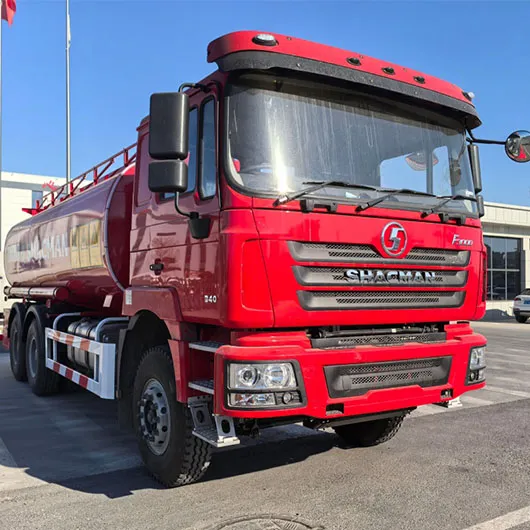
This product page gives one of the clearest answers: engine selection, tank structure, fuel system configuration, material and component selection, and application-oriented setup. In simple terms, the customization options are built around the job, not just cosmetics.
For example, a buyer may want a multi-compartment body, specific emission rules for the destination market, a certain dispensing arrangement, or a different drive type. All Lifecycle explicitly says specifications can be customized according to application, destination regulations, and customer requirements, including drive type, engine power, emission standard, and body configuration.
That is exactly what overseas B2B customers usually ask for. They want the truck to fit local work and local compliance. In my view, that is far more important than generic “best price” language. A tanker truck is engineered to solve a real transport problem, and the right customization is what turns a decent truck into a reliable fuel-delivery asset.
Common buyer requests
- Engine brand and output
- Tank compartment count
- Flow meter and fuel dispenser setup
- Drive layout and market compliance
- Material choices for corrosion resistance
- Branding and export documentation support
What should buyers ask before requesting a quotation?
Start with the route and the product. Tell the exporter what you will carry, how far you will run, and what road conditions the truck will face. The ordering guide on the page specifically asks buyers to share transport tasks, average payload, road conditions, route distance, and local regulations before quotation.
Then ask about shipping, inspection, and support. All Lifecycle says it prepares the trucks, carries out pre-delivery inspection, and provides loading photos, shipping schedules, and export documents. The FAQ also states that photos and videos about what is shacman-style truck condition are provided before shipment, and that long-term technical support plus spare-parts assistance are available.
This is where the exporter’s role matters as much as the truck itself. A serious buyer is not just looking for a truck for sale. They are looking for a partner that understands configuration, export timing, customs paperwork, and how to keep the vehicle working after arrival.
Quotation checklist
- Product to carry: diesel, gasoline, refined oils, or even some crude oil-related transfer discussions where legally appropriate
- Tank capacity and compartment needs
- Required power range: 340hp, 380hp, or other
- Destination market rules
- Shipping budget and preferred method
- Need for spare parts and remote support
Why does All Lifecycle’s business model appeal to importers and project buyers?
Because it reduces sourcing friction. The FAQ says the company is a professional export-oriented truck supplier in China that works closely with leading manufacturers such as Sinotruk and Shacman, while also managing its own truck preparation facilities. It supplies both new and high-quality used trucks and exports mainly to Africa, the Middle East, Southeast Asia, Central Asia, and South America.
For an importer, that means one source can cover multiple truck categories. For a project buyer, it means more room to combine a new shacman fuel tanker truck with a refurbished support truck or compare a Shacman setup with a sinotruk howo alternative. That is very useful when budgets are tight but uptime still matters.
I think this is the quiet strength of the offer. It is not only about one truck product. It is about helping a buyer build a workable fleet plan.
Case insight: when does a 20m³ tanker make more sense than a larger fleet unit?
Imagine a regional fuel distributor serving several stations across mixed urban and highway routes. A huge trailer may carry more, but it can be harder to deploy, slower to unload on tight sites, and less flexible for varied delivery points. A 20m³ tank truck often makes more practical sense here.
Now imagine a contractor with mining and roadwork customers. The business may run one shacman tanker for regular fuel delivery, one tipper for site material, and perhaps a mini dump or service unit for smaller support work. In that case, one medium-capacity oil tanker can keep the rest of the fleet moving without the overhead of a larger 3 axle trailer system.
That is why many buyers do not ask only “What is the biggest tanker?” They ask “What is the right tanker for my route and customers?” That is the smarter question.
FAQs
What is the SHACMAN Automobile 20m³ Fuel Tanker Truck mainly used for?
It is mainly used for bulk fuel distribution, petroleum logistics, and long-distance delivery of refined oils such as diesel and gasoline. The product page positions it specifically for safe and efficient fuel transportation.
Can this fuel tanker truck be customized for different markets?
Yes. All Lifecycle says the truck can be customized by drive type, engine power, emission standard, tank structure, and body configuration based on the application and destination market.
Does the truck support multiple fuel types in one tank?
It can. The page states that an optional compartmentalized tank design is available, allowing simultaneous transport of different fuel types.
Why are aluminum alloy valves and manhole covers important?
They improve corrosion resistance, sealing reliability, and operational safety. Those points are specifically highlighted in the product overview and technical section.
Does All Lifecycle sell only new trucks?
No. The FAQ says the company supplies both brand-new trucks and high-quality used trucks for global markets.
How can I get pricing and fleet recommendations?
The product page says buyers should contact the sales team through the website inquiry form and provide application details, quantity, and destination country to receive an accurate proposal.
Get a Quote
We will reply you within 24 hours. If for urgent case, please add WhatsApp/WeChat: +86 17686600717,. Or call +86 17686600717 directly.
*We respect your confidentiality and all information are protected.
We will only use your information to respond to your inquiry and will never send unsolicited emails or promotional messages.