











Used Dump Trucks for Sale: How to Buy Factory-Refurbished HOWO & Shacman Tippers from China
By Shandong All Life Cycle Automobile — Export Sales & Refurbishment Team | Heavy-Truck Export Desk | Published / Updated: July 2026
A factory-refurbished dump truck is a used HOWO or Shacman tipper that has been dismantled, inspected, and rebuilt to a documented standard before export. Buying one well comes down to three checks: how deep the refurbishment goes, whether the axle and emission spec suit your destination, and whether the export paperwork is in order.
The gap between a repainted yard truck and a properly rebuilt one is where most buyers lose money. Most of what follows is about telling the two apart before your deposit leaves the bank.
What “factory-refurbished” actually covers
“Refurbished” has no legal definition in the used-truck trade, which is exactly why the word gets stretched. On one end of the range sits a cosmetic job: pressure-wash, respray, new decals, and a truck that photographs well. On the other end sits a driveline rebuild, where the engine and gearbox are opened, worn parts replaced, and the chassis checked for cracks and past welding.
Both get advertised with the same word. The price difference between them can be larger than the shipping cost, so the first question to a seller is never “is it refurbished” but “what was replaced, and can you show the record.”
A plant-based refurbishment differs from a yard flip in one practical way: the work happens on a line with inspection stages rather than in an open lot. Our parent plant runs a 12,000-unit annual modification capacity under an ISO 9001 quality system, with 3C and export certifications in place, which means a unit passes through defined checkpoints instead of a single mechanic’s judgment. That does not make every refurbished truck identical, but it makes the process auditable, and an auditable process is something you can ask to see.
A common mistake here: treating a fresh paint job as evidence of mechanical work. It is the opposite. A truck that has just been resprayed is harder to inspect, because paint hides frame repairs and rust. Ask for photos taken before the respray.
The checklist to run before you wire a deposit
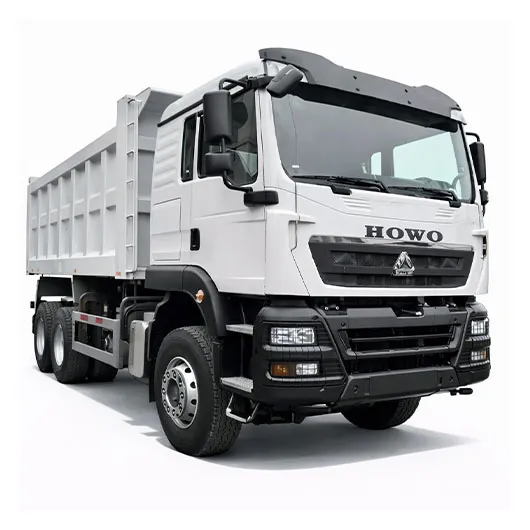
You will rarely stand next to the truck before it ships, so this list is what you ask the seller to document with photos, video, and readouts. Run it in order.
- Engine cold-start on video.Ask for a cold start, not a warm one. Watch exhaust colour in the first thirty seconds — blue means oil burn, heavy white after warm-up can mean coolant. Listen for knocking.
- Gearbox and clutch check.Request a short drive video through the gear range. Grinding on the shift or a slipping clutch under load is a rebuild you will pay for later.
- Frame and cross-members.Get straight-on shots of the chassis rails. Look for weld beads that do not match the factory line, ripples, or filler — these point to past accident repair.
- Hydraulic tipping cycle.A dump truck lives on its cylinder. Ask for a full raise-and-lower under an empty bed, and watch for drift, leaks at the seals, and hesitation partway up.
- Brakes and air lines.For 6×4 and 8×4 units running heavy loads, air-brake condition is a safety item, not a detail. Request an air build-up time and a look at the lines for chafing.
- Tyres, matched as a set.Mismatched tyre brands or tread depths across an axle change handling on loose ground and signal a truck patched to sell.
- Documentation package.Chassis number matching the paperwork, a refurbishment record listing replaced parts, and export certificates. A missing or vague record is itself a finding.
If a seller resists any single item on this list, that resistance is data. A plant that rebuilt the truck can produce the record; a yard that flipped it usually cannot.
Match the truck to where it will actually work
The most expensive buying error is not overpaying. It is landing a truck that runs poorly on your fuel or breaks limits on your roads, because neither problem can be fixed after shipping.
Start with emissions. A late-model unit built to a China VI standard carries a DPF and SCR system tuned for low-sulfur diesel. Run it on the high-sulfur fuel still common in parts of Africa and Central Asia and those systems clog, derate the engine, and turn into a recurring bill. For those markets, an older-emission unit with simpler mechanical injection is often the more serviceable choice, not the “worse” one. This is where a refurbished truck holds an advantage a new unit cannot: you can select the emission generation that suits the fuel you actually have.
Odometer readings deserve suspicion. On used export trucks the number is frequently unreliable, and even an honest reading tells you less than the work history. A tipper that spent its life on short quarry cycles has taken more punishment than a highway hauler showing double the kilometres. Ask about the previous duty, not just the mileage.
Then check axle configuration against your ground and your load limits:
- A 4×2is light and economical, suited to firm surfaces and municipal or lighter site haul.
- A 6×4is the general-purpose workhorse for mixed roads and standard construction.
- An 8×4spreads weight across more axles for the heaviest quarry and mining work, and for regions where per-axle road limits, not total payload, set the ceiling.
Buying an 8×4 where a 6×4 would do adds cost and fuel; buying a 6×4 where the road law demands more axles can leave the truck unable to load legally.
6×4 or 8×4? Reading the configuration table
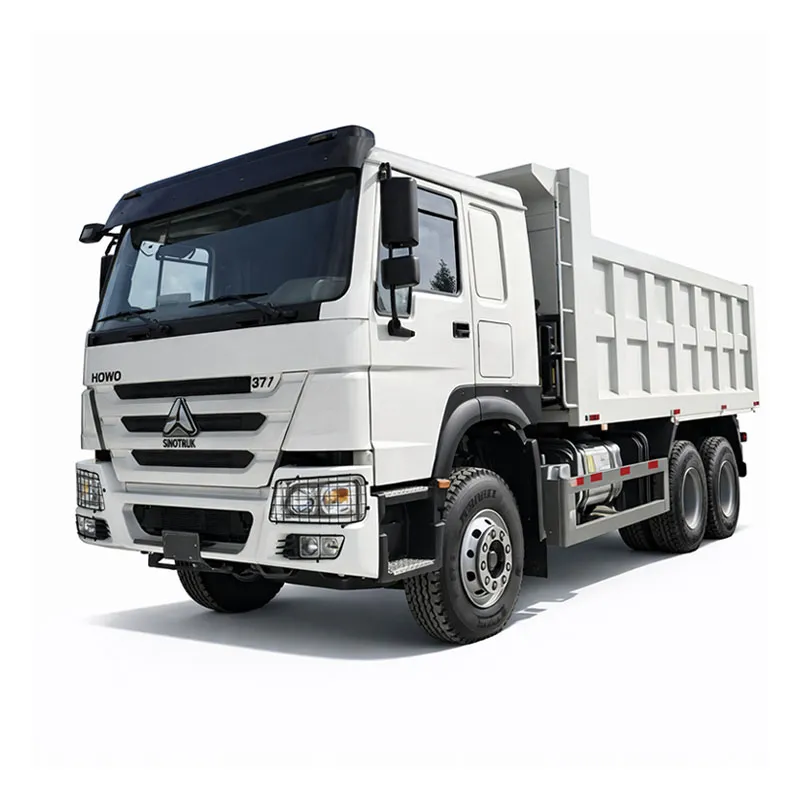
The refurbished dump range covers Sinotruk HOWO, Shacman, and FAW platforms across a 20–50 tonne envelope, in 4×2, 6×4, and 8×4 layouts. Configuration, not brand badge, decides most of the fit:
| Configuration | Drive layout | Typical payload class | Where it earns its keep |
| 4×2 | Single drive axle | ~20 t class | Municipal haul, lighter sites, firm roads |
| 6×4 | Tandem drive | ~25–40 t | General construction, mixed road conditions |
| 8×4 | Twin steer + tandem drive | Up to ~50 t | Heavy quarry, mining, axle-limited road networks |
Brand tendencies within that range are practical rather than absolute. HOWO carries the widest spare-parts presence across Africa and Southeast Asia, which shortens downtime when something fails far from a dealer. Shacman is the one buyers reach for on brutal terrain and heavy payloads. FAW suits fleets that want one platform standardised across many units for predictable maintenance.
Unit-level details such as engine output, exact mileage, build year, and the depth of refurbishment on a specific truck vary per vehicle, and are confirmed on the individual quote rather than assumed from the class. Send the destination and the payload you need, and the config narrows quickly.
Refurbished, new, or a private used unit
Three routes lead to a working tipper. They trade off differently, and the right pick depends on your capital and your tolerance for the unknown.
| Factory-refurbished (plant) | New unit | Private used / marketplace | |
| Upfront price | Below new | Highest | Lowest, but unpredictable |
| Mechanical certainty | Rebuilt to a documented process, road-tested | Full | Unknown; rests on the seller’s word |
| Documentation | Export docs plus a refurbishment record | Complete | Frequently incomplete |
| Emission flexibility | Choose the generation that fits your fuel | Newest standard only | Whatever the unit happens to be |
| Lead time | Stock-dependent; rebuild adds days | Production slot | Fast if it sits in a yard |
| Parts and after-sales | Exporter-supported | Dealer network | Your problem after payment |
Compared with a private used unit pulled off a marketplace listing, a plant-refurbished truck trades a slightly higher price for a documented rebuild and traceable paperwork. That trade is the whole point: the cheaper listing can be the more expensive truck once a hidden frame repair or a tired cylinder surfaces on site.
The honest downsides of the refurbished route are worth naming, because they affect the decision. You usually cannot test-drive before shipping, so the refurbishment record and a third-party pre-shipment inspection carry the risk instead of your own hands. An emission mismatch is effectively permanent once the truck lands. And if your exact configuration is not in stock, the rebuild and export cycle takes time a marketplace unit sitting in a yard does not. None of these is a reason to avoid refurbished trucks; each is a reason to insist on documentation and to fix the spec before you order.
Getting it to port
Two shipping methods dominate, and the choice affects both cost and risk.
Roll-on/roll-off (Ro-Ro) drives the truck onto a vessel and is usually cheaper for a running unit. Containerised shipping costs more but protects the truck and suits buyers whose port lacks Ro-Ro handling or who want the vehicle enclosed. For a single tipper to a major port, Ro-Ro is the common default; for several units or a difficult destination, the numbers can flip.
The paperwork matters more than the method. A clean export moves on a commercial invoice, a packing list, a certificate of origin, and, depending on the destination, a pre-shipment inspection certificate. Some countries require the inspection before the vessel loads, and a truck that arrives without it can be held at the destination port. Confirm your country’s requirement first; it changes what has to happen before the truck leaves China.
What it costs
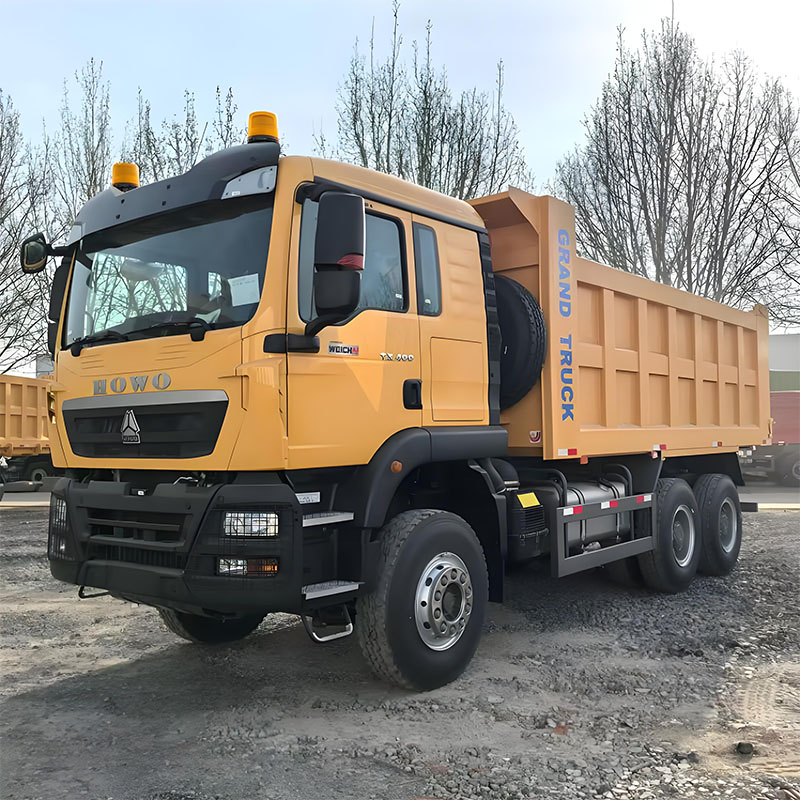
There is no honest fixed price for a used dump truck, and any seller who quotes one before seeing your spec is guessing. Price moves with build year, mileage and duty history, emission generation, axle configuration, refurbishment depth, and shipping route. A high-hour 6×4 with a cosmetic refresh and a low-hour 8×4 with a driveline rebuild are different products that happen to share a category.
What holds across the range: a refurbished unit lands below a comparable new truck on upfront cost, and the spread depends on how much rebuilding the specific truck received. For a real figure, send the destination, payload, and preferred configuration and ask for a per-unit quote against a named truck. That is the only price worth acting on.
Your next step is narrower than “browse dump trucks.” Write down your destination fuel type, your road axle limits, and your payload, then ask a seller to match a specific unit to those three constraints and show the refurbishment record. A truck chosen against those constraints will still be working when a truck chosen on price alone is parked.
FAQ
Q: How much cheaper is a used dump truck than a new one? A used unit lands below a comparable new truck on upfront cost, but the exact gap depends on the truck’s age, mileage, emission standard, and how much refurbishment it received. A cosmetic refresh and a driveline rebuild sit at very different prices. Ask for a per-unit quote rather than a category average.
Q: What is the difference between “used” and “refurbished”? Used describes any second-hand truck. Refurbished should mean work was done — but because the word is unregulated, it ranges from a respray to a full mechanical rebuild. The distinction that matters is the documented refurbishment record showing which parts were replaced.
Q: Should I buy a 6×4 or an 8×4? A 6×4 covers most general construction on mixed roads. Choose an 8×4 for the heaviest quarry and mining work, or where per-axle road limits — not total payload — cap what you can legally load. Match the axle count to your ground and your local road law.
Q: Will a China VI truck run on my local diesel? Only if your market has low-sulfur diesel. China VI units use DPF and SCR systems that clog on high-sulfur fuel. In markets where high-sulfur diesel is common, an older-emission unit with simpler injection is often more serviceable. Confirm your local fuel before choosing the emission generation.
Q: Can I inspect the truck before it ships? Usually not in person. That is why the refurbishment record, cold-start and hydraulic-cycle video, and a third-party pre-shipment inspection matter — they carry the verification you cannot do by hand. A seller who can produce all three is easier to trust than one who cannot.
Q: Do refurbished export trucks come with any after-sales support? Support terms vary by exporter and should be confirmed in writing before payment, including what is covered and for how long. Ask specifically about replacement-part supply to your region, since parts availability, not the warranty wording, decides your real downtime.
Get a Quote
We will reply you within 24 hours. If for urgent case, please add WhatsApp/WeChat: +86 17686600717,. Or call +86 17686600717 directly.
*We respect your confidentiality and all information are protected.
We will only use your information to respond to your inquiry and will never send unsolicited emails or promotional messages.