











Articulated vs Rigid Dump Trucks: Which Fits Your Site
Автор: Alllifecycle
Publish Time: 2026-08-17
Tom | Corporate Editorial Team, ALL LIFECYCLE Published: August 17, 2026
Articulated dump trucks (ADTs) pivot between cab and bed to cross soft, wet, or uneven ground; rigid trucks like 6×4 and 8×4 configurations keep a fixed frame for higher payload on firmer haul roads. The right pick depends on ground conditions and haul distance, not just size.
What Actually Separates These Two Truck Types
The difference isn’t just “one bends in the middle.” A rigid самосвал steers the way a conventional truck does — the front axle turns, the frame and bed stay in one piece, and the load sits over a fixed wheelbase. An articulated dump truck has a hinge joint between the tractor section and the dump body, paired with an oscillating rear bogie that lets each wheel on the rear axles follow the ground independently rather than staying locked to a single plane.
That oscillating bogie is the real engineering story. It’s what lets an ADT keep traction on rutted, saturated, or loose ground where a rigid truck’s wheels would start losing contact one at a time. Rigid trucks trade that flexibility for a simpler drivetrain, a lower parts count, and — generally — a lower purchase price.
The 6×4 and 8×4 labels that ALL LIFECYCLE and other Chinese manufacturers use map to the tandem-axle and tri/quad-axle terminology that U.S. and international buyers search for.
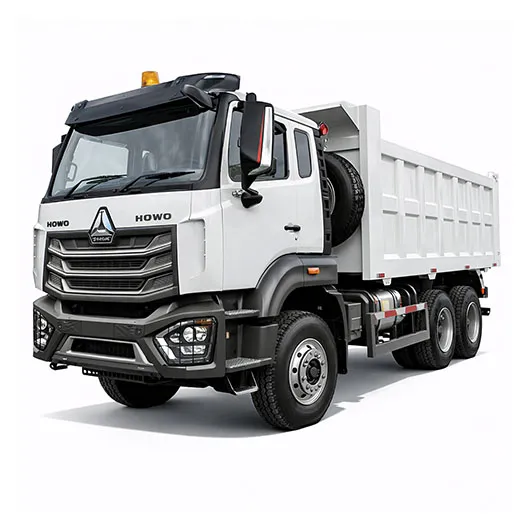
Where Rigid 6×4 and 8×4 Trucks Win
On graded quarry roads, paved haul routes, or any site where the truck spends real time on public roads between loads, a rigid configuration is usually the more practical choice:
- Higher road speed between load and dump points, which matters on longer hauls
- Wider global parts and service network, since rigid trucks are the more common category worldwide
- Lower purchase price for comparable payload class
- Simpler maintenance — fewer hydraulic joints, no articulation pin to service
- Larger used and refurbished market, which is where ALL LIFECYCLE’s sourcing work concentrates
The drawback is real and worth stating plainly: on loose fill, mud, or freshly cut haul roads, a rigid truck’s fixed axle geometry means it can lose drive traction faster than an ADT built for that exact ground. A rigid 8×4 stuck axle-deep after a rain event is a familiar problem on sites that mix graded and ungraded sections.
Where Articulated Dump Trucks Earn Their Keep
ADTs exist because some ground genuinely defeats a rigid frame. Open-pit mining benches, forestry roads, land-clearing sites, and anything with standing water or soft fill favor the pivot-steer, independent-bogie design. The truck can put power to all wheels through a turn without the frame twisting the axles out of contact with the ground.
That capability comes at a cost. ADTs typically carry a higher purchase price than a rigid truck in a similar payload class, the specialist parts network is narrower — a handful of manufacturers dominate the category — and road speed is lower, which matters less on an enclosed mine site but matters a great deal if the truck also needs to travel between locations on public roads. Used and refurbished ADT supply is thinner globally than the rigid самосвал market, which is one reason export suppliers that focus on rigid configurations rarely stock them.
Articulated vs Rigid Dump Trucks: Side-by-Side
| Factor | Rigid (6×4 / 8×4) | Articulated Dump Truck |
| Рулевое управление | Front-axle steer, fixed frame | Hinge joint + oscillating rear bogie |
| Best terrain | Graded, paved, or compacted haul roads | Soft, wet, uneven, or loose ground |
| On-highway travel | Yes, standard road speeds | Limited — built for off-road use |
| Typical use case | Quarry-to-plant hauls, construction sites, municipal work | Mine pits, forestry, land-clearing |
| Purchase price (same payload class) | Generally lower | Generally higher |
| Global parts network | Wide — common category | Narrower — specialist manufacturers |
| Used/refurbished supply | Larger secondary market | Thinner secondary market |
| Stocked by ALL LIFECYCLE | Yes — new and refurbished | Not stocked |
Compared to marketplace listings that lump every “самосвал” style under one generic filter, the distinction above is what actually determines whether a truck survives a wet season on your site — not the size class on the listing page.
The Axle-Count Misconception That Trips Up First-Time Buyers
Buyers new to sourcing sometimes assume that because an ADT has more visible complexity — a hinge, a bogie, often three axles — it must also out-haul a similarly sized rigid truck. It doesn’t work that way. Payload capacity comes from axle load rating, frame spec, and engine output, not from the articulation joint itself. A well-specified rigid 8×4 can carry more on a firm haul road than a mid-size ADT designed primarily for soft-ground mobility rather than maximum tonnage.
This is the same logic behind why axle count alone doesn’t predict payload on rigid trucks either, as covered in our tri-axle vs quad-axle comparison: a driven axle and a tag or pusher axle contribute very differently to what a truck can legally and mechanically carry. Articulation adds a mobility advantage on bad ground. It does not, by itself, add carrying capacity.

How to Decide Which Type Fits You
- Map your haul route surface. Note where the route is graded or paved versus raw cut ground, and how much of the daily route falls into each category.
- Check seasonal ground conditions. A site that’s firm in the dry season and saturated for three months of rain needs a different answer than a permanently graded quarry floor.
- Confirm the haul distance and required road speed. Longer hauls between load and dump points favor rigid trucks; short, off-road cycles favor ADTs.
- Price total delivered cost, not just the truck. Include parts availability and service turnaround in your country, not only the sticker price.
- Match payload need to axle configuration, not truck category. Ask for the specific axle load rating and GVW for the model under consideration rather than assuming category size settles the question.
Why ALL LIFECYCLE Doesn’t Stock Articulated Dump Trucks
ALL LIFECYCLE’s new and refurbished lineup is built around rigid 6×4 and 8×4 configurations on Sinotruk HOWO and Shacman platforms, drawing on manufacturing experience tracing back to 2006 through its parent operation,That manufacturing operation holds ISO 9001:2008 quality management certification, a standard maintained by the International Organization for Standardization — buyers should confirm current certificate validity directly with the sales team before treating it as a live selling point.
Staying focused on rigid configurations is a sourcing decision, not a gap the company is trying to paper over: it’s where the inspection, refurbishment grading, and export logistics experience is concentrated. If a site genuinely needs an ADT for soft or wet ground, that’s a different manufacturer category worth sourcing separately. For the graded-road, tandem-and-tri/quad-axle work most construction and quarry contractors run day to day, a rigid 6×4 or 8×4 covers the job. Pricing on any configuration depends on condition, engine spec, and destination — request a quote for the specific model and route you’re planning.
FAQ
Q: Can a rigid 8×4 dump truck handle rough or unpaved jobsite conditions?
A: Within limits. A rigid 8×4 handles graded, compacted, or lightly rutted ground without trouble. It struggles specifically on saturated, loose, or freshly cut fill where wheels can lose contact — that’s the terrain where an ADT’s oscillating bogie has the advantage.
Q: Is an articulated dump truck always more expensive than a rigid truck?
A: In a comparable payload class, yes, ADTs generally carry a higher purchase price and a narrower parts network, since fewer manufacturers build them and the design carries more moving parts.
Q: Does ALL LIFECYCLE sell or source articulated dump trucks?
A: No. ALL LIFECYCLE’s lineup is rigid 6×4 and 8×4 dump trucks, new and refurbished. For ADT sourcing, a specialist in that category is a better fit.
Q: Which type has more payload capacity — articulated or rigid?
A: Neither category wins by default. Payload comes from axle load rating, frame spec, and engine output on the specific model, not from whether the truck is articulated.
If your haul route is mostly graded or paved, start by comparing 6×4 and 8×4 axle load ratings against your tonnage target rather than the truck category — the configuration breakdown and our used-truck sourcing guide cover how to read those numbers before requesting a quote.
Получить предложение
Мы ответим вам в течение 24 часов. В случае срочных запросов, пожалуйста, добавьте WhatsApp / WeChat: +86 17686600717. Или позвоните напрямую по номеру +86 17686600717.
*Мы уважаем вашу конфиденциальность и защищаем всю информацию.
Мы будем использовать вашу информацию только для ответа на ваш запрос и никогда не будем отправлять нежелательные электронные письма или рекламные сообщения.