











Refurbished End Dump Trucks for Sale: How They Work and Who They Suit
Tom | Corporate Editorial Team, ALL LIFECYCLE | Published August 26, 2026
An refurbished end dump truck carries material in a fixed rear-hinged body and unloads by raising the front of the bed with a hydraulic hoist, letting the load slide out through the rear tailgate. It is the standard rigid dump configuration used across construction, quarry, and municipal hauling worldwide.
What Makes a Truck an “End Dump”?
The name describes the discharge point, not the chassis. A hydraulic ram sits under the front of the dump body, between the cab and the box. When the operator raises it, the body pivots on hinges mounted at the rear, near the back axle, and the tailgate — hinged at the top, latched at the bottom — swings open under the weight of the shifting load. Material exits behind the truck, not to the side and not underneath it while the truck is moving.
Some markets call the same vehicle a “tipper truck.” The mechanism is identical; the term just shifts by region. What separates an end dump truck from other dump configurations is where and how the load comes out, and that distinction affects site layout, unloading speed, and which jobs the truck is actually suited for.

End Dump vs. Side Dump vs. Bottom Dump
| Feature | End Dump | Side Dump | Bottom Dump |
| Discharge point | Rear, through tailgate | One side, full body tilt | Floor gates, underneath the trailer |
| Unloads while moving | No | No | Yes, in a continuous windrow |
| Typical unit | Rigid truck, single frame | Truck or trailer, tilts sideways | Long trailer pulled by a tractor |
| Clearance needed to dump | Open space behind the truck | Open space to one side | None — gates open beneath the load |
| Common application | General construction, quarry haul, demolition debris | Confined sites, edge-of-road placement | Highway paving, long-haul aggregate |
| ALL LIFECYCLE catalog | Core product — 6×4 and 8×4 configurations | Outside current lineup | Outside current lineup |
For a contractor comparing options, the practical question is rarely “which is the best dump truck” — it is which discharge method fits the job site’s space and the material being moved. Compared to trailer-based bottom dump setups common in North American aggregate work, a rigid end dump truck trades continuous unloading speed for a tighter turning radius and one less unit to register, insure, and maneuver.
The Rear-Dump Cycle, Step by Step
- Position the truck with the rear clear of overhead obstructions, on ground rated to carry the loaded axle weight.
- Engage the power take-off (PTO) to route engine power to the hydraulic pump.
- Release the tailgate latch — manual pull, remote cable, or an automatic linkage, depending on the spec ordered.
- Raise the hoist. Multi-stage telescopic cylinders extend in sequence, lifting the front of the body.
- Let material slide out the rear as bed angle increases, typically reaching 45–50 degrees at full lift.
- Lower the body fully before moving off the dump point.
- Re-latch the tailgate and disengage the PTO once the bed is seated.
Skipping step 6 — driving with the bed still raised or partially raised — is one of the more common causes of overhead-line and gantry strikes on job sites, since the loaded height of a fully raised end dump body can exceed the truck’s normal travel clearance by several meters.
Where End Dump Trucks Earn Their Keep
Rigid end dump trucks handle the bulk of general construction and quarry haul work: sand, gravel, crushed stone, road base, and demolition debris moved from a source point to a drop point in single loads. Municipal contractors use them for snow removal debris and street repair material. Mixed-fleet operators running both new and refurbished units often keep end dump trucks as the workhorse category, reserving specialized configurations — mixers, tankers, cranes — for jobs that need them.
The configuration suits short-to-medium haul distances where the truck returns to the same load point repeatedly. For continuous, high-volume paving work where material needs to lay down in a moving line rather than a single pile, bottom dump trailers are the better-suited tool, which is part of why ALL LIFECYCLE positions end dump as the core product rather than the only one a buyer should consider.
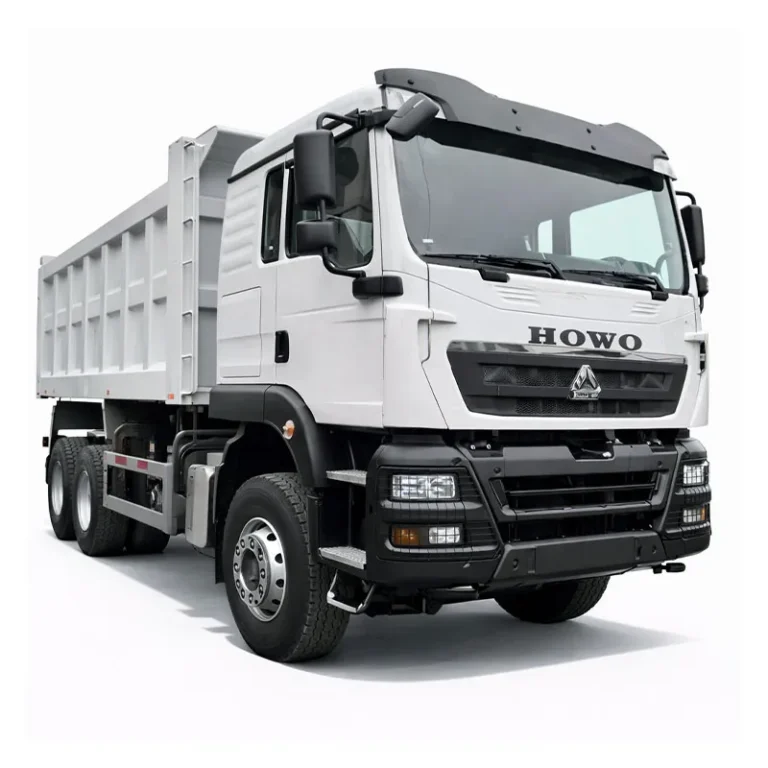
6×4 and 8×4 End Dump Configurations from ALL LIFECYCLE
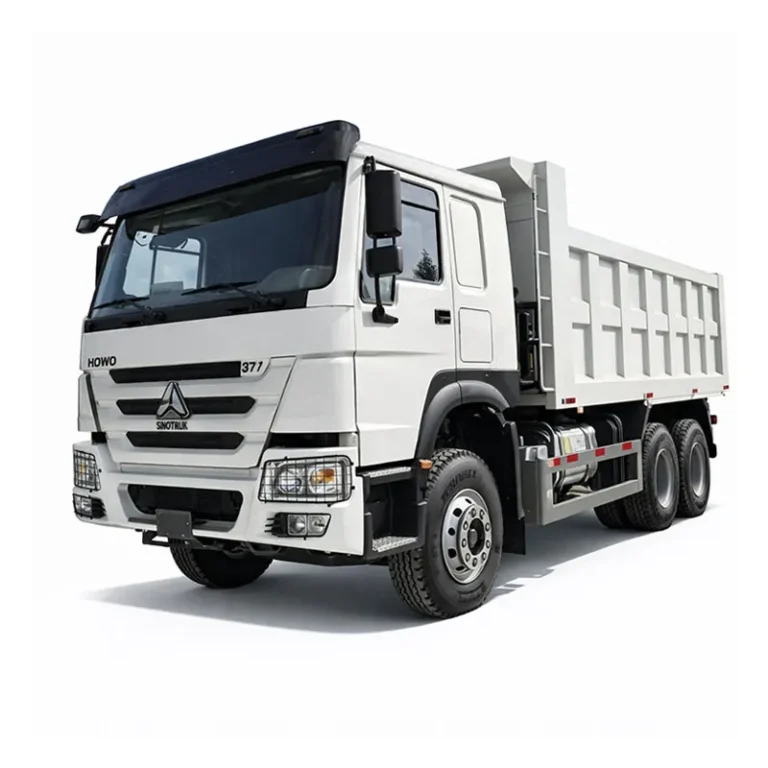
ALL LIFECYCLE’s end dump lineup is built on Sinotruk HOWO and Shacman platforms in two axle configurations: 6×4 (three axles, rear two driven) and 8×4 (four axles, rear two driven, front two steer). The 8×4 layout adds a second steer axle and more body-support length, which is why it is the more common spec for reinforced, heavier-duty haul work. Axle count on its own does not set payload — a fourth axle that is not driven still adds carrying and support capacity, but it is the combination of driven axles, chassis rating, and body length together that determines how much a specific unit can legally and practically carry.
Exact payload, engine output, and box dimension figures vary by build and are not yet published as a general specification sheet — ALL LIFECYCLE provides these per configuration on request rather than as a single catalog number, since a reinforced 8×4 built for quarry work and one built for lighter municipal haul are specified differently. A dedicated 6×4 and 8×4 product spec page is in development; until it goes live, request a quote for the exact configuration you need.
ALL LIFECYCLE’s manufacturing partner has been building trucks since 2006 and states GB/T 19001-2008 and ISO 9001:2008 quality management system certification, aligned with the international ISO 9001 standard maintained by the International Organization for Standardization for consistent production processes.
Ground Conditions: The Tip-Over Risk Buyers Overlook
Raising the hoist shifts the truck’s center of gravity up and back, and it does so with material still inside the body that can slide unevenly before it clears the tailgate. On soft, sloped, or uneven ground, that combination raises rollover risk in a way that does not apply the same way to a side dump or a bottom dump trailer, since neither lifts the load mass as high above the chassis. The fix is procedural, not mechanical: dump on level, compacted ground, avoid raising the bed while the truck sits on a cross-slope, and account for wind loading on tall loads at exposed sites. Buyers moving from side dump or bottom dump equipment sometimes miss this because it is not a consideration with those configurations at all.
Trade-Offs to Weigh Before You Buy
An end dump truck has fewer moving parts than a truck-and-trailer combination — no separate trailer to align, no fifth wheel or pintle hook to maintain — and a tighter turning radius that helps on urban or residential sites where trailer combinations struggle to maneuver. Parts and service support for 6×4/8×4 rigid trucks are widely available across most export markets these platforms serve. Registration is also simpler in most jurisdictions: one unit, one set of permits, rather than a truck-and-trailer combination that some countries license separately.
The trade-offs run the other way on space and volume. An end dump truck needs open ground behind it to lift and unload, which does not work in very tight yards where a side dump can discharge against a wall instead. It cannot unload while moving, so it is not the right tool for continuous windrow paving. And single-unit payload is capped by axle count and local road-weight regulations — operations that need more material moved per trip typically add trailer combinations rather than scale up a single rigid end dump truck.
Price depends on configuration, condition, engine and emission spec, refurbishment grade, order quantity, and destination country, so ALL LIFECYCLE quotes each end dump order individually rather than publishing a flat price list. Buyers weighing a refurbished unit against new can also review our guide to sourcing used dump trucks from China for the inspection steps worth running before ordering.
FAQ
Q: What is an end dump truck used for?
A: Refurbished End dump trucks haul loose material such as sand, gravel, crushed stone, or demolition debris and discharge the full load at one drop point, which makes them the standard choice for construction sites, quarries, and general aggregate delivery.
Q: What’s the difference between an end dump truck and a tipper truck?
A: In most export markets, “tipper truck” and “end dump truck” describe the same rear-discharge mechanism; the term just varies by region, with “tipper” more common in African and South Asian usage and “end dump” more common in North America.
Q: How much can a 6×4 or 8×4 end dump truck carry?
A: Payload depends on chassis configuration, body length, and the road-weight limits of the destination country, so ALL LIFECYCLE provides exact payload figures per build rather than a single published number — request a quote with your target market to get a specific figure.
Q: Can end dump trucks work on unpaved or off-road sites?
A: Yes — reinforced 8×4 end dump trucks are commonly specified for quarry and mine-adjacent haul roads, though ground conditions at the dump point matter as much as the haul road itself; see the ground-condition guidance above before committing to a site.
Q: Is a refurbished end dump truck a reasonable option instead of new?
A: Yes, for many buyers a professionally refurbished end dump truck lowers upfront cost while keeping the same rear-dump mechanism as a new unit; grading and inspection standards determine how much life is left in the hoist, hinges, and tailgate seal before purchase.
احصل على عرض أسعار
سوف نرد عليك خلال 24 ساعة. إذا كانت الحالة عاجلة، يرجى إضافة واتساب / وي شات: +86 17686600717، أو الاتصال مباشرة على +86 17686600717.
*نحن نحترم سريتك وجميع معلوماتك محمية.
لن نستخدم معلوماتك إلا للرد على استفسارك ولن نرسل أبداً رسائل بريد إلكتروني غير مرغوب فيها أو رسائل ترويجية.