











New Dump Trucks for Sale: What Overseas Buyers Should Check
Tom | Corporate Editorial Team | Published September 1, 2026
Buying a new dump truck for export adds steps a domestic buyer skips entirely: certificate verification, shipping documentation, and warranty terms that have to survive a border crossing. This guide walks through what to confirm before placing a deposit, not just what the truck looks like on a spec sheet.
New Doesn’t Just Mean “Off the Assembly Line”
For an overseas buyer, “new” carries a second meaning beyond zero mileage: it means the paperwork trail starts clean. A new unit hasn’t been re-registered, hasn’t picked up a refurbishment grade, and hasn’t accumulated the inspection history a used import requires. That’s a real advantage for financing and resale — but it doesn’t remove the need to check documentation. A new chassis can still ship with incomplete export paperwork if the supplier treats it as an afterthought.
This distinction matters more once you’re comparing quotes. A buyer evaluating used dump trucks for sale is already budgeting for inspection reports and refurbishment grading. A new-truck buyer often assumes documentation is automatic. It isn’t.

The Certification Checklist Before You Wire a Deposit
Three categories of paperwork determine whether a truck can legally enter your market and register there. Ask for all three before payment, not after.
| Document | What It Confirms | How to Verify |
| CCC / 3C Certification | Product meets China’s mandatory compulsory certification for road vehicles | Request the certificate number and cross-check it against the manufacturer plate on the chassis |
| Quality Management Certification (ISO 9001 / GB/T 19001) | The manufacturing operation follows a documented quality system | Ask for the current certificate — not the year it was first obtained — and confirm the issuing body and scope directly with the supplier |
| Destination-market compliance documents | The specific model can be registered and operated in your country | Confirm requirements with your own customs broker; these vary by destination and aren’t standardized across export markets |
ISO 9001, maintained by the International Organization for Standardization, sets requirements for how a manufacturer documents and controls its quality processes — it’s a system certification, not a guarantee about any individual vehicle’s condition. Treat a supplier’s ISO reference as a starting point for verification, not as the final answer. A supplier who can’t produce a current certificate number on request is a bigger red flag than one selling at a slightly higher price.
The Misconception That Costs Buyers Money: More Axles Isn’t More Payload
Contractors comparing new trucks by axle count often assume an 8×4 automatically outperforms a 6×4 on payload, or that adding driven axles improves capacity the way it improves off-road traction. Neither holds up. Axle count changes weight distribution and legal gross vehicle weight limits in your destination market — it doesn’t by itself change how much cargo the frame and suspension are rated to carry. Two trucks with the same axle configuration can have meaningfully different payload ratings depending on frame reinforcement, suspension type, and engine output. This is the same distinction covered in our tri-axle vs. quad-axle comparison — it’s worth reading before axle count becomes the deciding factor in your quote comparison.
Platform Choice: Where the Real Differences Sit
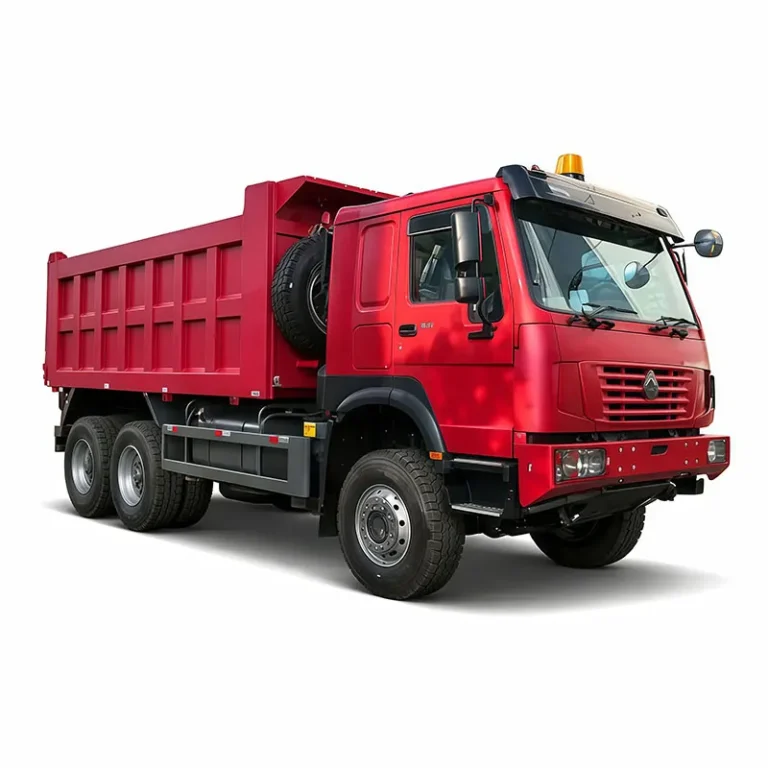
New dump trucks in the export market are typically built on one of a small number of established Chinese commercial chassis platforms, most commonly Sinotruk HOWO and Shacman. Brand name alone doesn’t tell you much; the configuration underneath it does. Engine emission tier, drive configuration (6×4 vs. 8×4), cab type, and body dimensions all move independently of which badge is on the grille, and two trucks from the same brand can be built for entirely different jobs.
This section intentionally stops short of listing specific engine outputs or payload figures by platform — those belong on dedicated 6×4 and 8×4 specification pages, which aren’t published yet. Once they exist, this section should link directly to them instead of describing the platforms in general terms.
Shipping and Documentation: From Order to Port
Once a truck and configuration are confirmed, the export process follows a consistent sequence. Skipping any of these steps is where delays and disputes usually start.
- Confirm the final specification in writing — engine, drive configuration, cab, and any special-purpose upper-body equipment, signed off before production.
- Request the export documentation package — commercial invoice, packing list, certificate of origin, and the specific compliance documents your destination requires.
- Verify the emission and safety certification applicable to your market before the truck is built, not after it arrives at port.
- Confirm the shipping method — roll-on/roll-off versus containerized — since this affects both cost and arrival condition.
- Agree on the delivery port and Incoterm (FOB, CIF, etc.) in the contract, not verbally.
- Request pre-shipment inspection photos or video of the completed unit before it’s loaded.
- Confirm the spare-parts package included with the order, since availability after delivery depends on what ships with the truck versus what has to be ordered separately later.
Warranty and After-Sales Support: Read the Fine Print
Overseas 4S-style support — sales, storage, maintenance, and spare-parts access — is available in selected markets, but the number and location of service points varies by region and isn’t something a buyer should assume without confirming it for their specific country first. Ask directly which services are available where the truck will operate, and get the warranty terms in writing before the order is placed, not summarized verbally by a sales contact.
Pricing: Why Two “New” Quotes Can Differ Significantly
New dump truck pricing is quotation-based rather than fixed, because it depends on variables that change with every order: engine and emission configuration, drive configuration, payload and body dimensions, special-purpose upper-body equipment, order quantity, spare-parts package, warranty coverage, destination country, certification requirements, shipping method, delivery port, and exchange rate. Two buyers asking about “the same truck” can receive different quotes because one specified a different emission tier or ordered a smaller quantity. Request a configuration-specific quote rather than a general price range — a general figure won’t reflect what you’ll actually pay.
FAQ
Q: Is a new dump truck always a better investment than a refurbished one for export?
A: Not automatically. New trucks remove refurbishment-grade questions but cost more upfront; refurbished trucks can offer lower entry cost if the inspection and grading documentation is solid. The right choice depends on your budget and how the truck will be used — see our used dump truck sourcing guide for the inspection checklist that applies either way.
Q: Can I get a fixed price list for new dump trucks before specifying configuration?
A: No. Pricing depends on the variables above, so a fixed list wouldn’t reflect what any individual buyer pays. A configuration-based quote is the accurate way to compare costs.
Q: Does a higher axle count mean a better resale value?
A: Not consistently. Resale value tracks configuration suitability for the buyer’s application more than axle count alone — a correctly specified 6×4 can outsell an oversized 8×4 in markets where road weight limits favor the lighter configuration.
Q: What’s the biggest documentation mistake overseas buyers make?
A: Treating certification and shipping paperwork as something to sort out after the deposit is paid, rather than before. Confirming the seven-step checklist above in writing, ahead of production, is what prevents delays at the destination port.
If you’re weighing a new order against a mixed-fleet purchase spanning multiple configurations, our custom and mixed-fleet procurement guide walks through how sourcing changes once more than one truck type is involved.
Get a Quote
We will reply you within 24 hours. If for urgent case, please add WhatsApp/WeChat: +86 17686600717,. Or call +86 17686600717 directly.
*We respect your confidentiality and all information are protected.
We will only use your information to respond to your inquiry and will never send unsolicited emails or promotional messages.