











Off-Road and 6×6 Dump Trucks for Sale: What to Know
Tom | Corporate Editorial Team, ALL LIFECYCLE | Published August 2026
A 6×6 dump truck has three axles with all six wheels driven, built for soft ground and steep grades. Most quarry and open-pit haul roads don’t need that; a reinforced 8×4 (four axles, two driven) carries more payload per trip at a lower operating cost. The right pick depends on ground condition, not on which spec sounds tougher.
“Off-Road” Covers Two Very Different Job Sites
Buyers typing “off-road camion-benne for sale” are usually describing one of two situations. The first is a genuine cross-country site — a new quarry access road that hasn’t been graded yet, a mine pit with loose overburden, or a flood-damaged route where a standard highway truck would bog down. The second, more common situation is an unpaved but compacted haul road inside an established quarry or mine, where the surface is rough and dusty but not soft or steep enough to require full-time all-wheel drive.
That distinction matters because it changes which drive configuration actually earns its keep. A truck built for the first scenario trades payload and fuel economy for traction. A truck built for the second scenario can keep a higher payload-to-weight ratio and still handle the terrain, provided the chassis and suspension are reinforced for the pounding.
6×6, 6×4, 8×4: What the Numbers Mean
Unlike the U.S. “tri-axle” or “quad-axle” convention, which counts total axles regardless of which ones drive, the 6×6/6×4/8×4 notation is a drivetrain formula used the same way by Chinese manufacturers and international buyers: the first number is total wheel positions, the second is how many are powered.
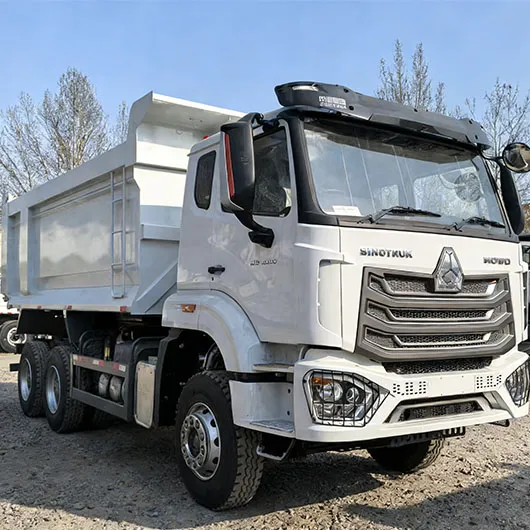
- 6×4 — three axles, two driven (rear tandem), one steering axle. Standard configuration for paved and light off-road work.
- 6×6 — three axles, all driven. Every axle contributes traction, at the cost of a heavier drivetrain and higher fuel burn per load.
- 8×4 — four axles, two driven. Adds a second steering or tag axle to spread weight and increase legal payload without adding a second driven axle.
Why Most Off-Road-Rated Fleets Run 8×4, Not 6×6
True 6×6 dump trucks exist and are built to order for extreme terrain — flooded mine access roads, loose sand haul routes, disaster-recovery sites. But they’re a narrow-use vehicle. The extra driven axle adds weight and mechanical complexity that most quarry and open-pit operations don’t need day to day, because the haul road itself is graded and compacted even if it’s unpaved.
For that broader off-road-rated segment, ALL LIFECYCLE’s core offering is the reinforced 8×4 dump truck: a four-axle, two-driven layout with a strengthened frame, upgraded suspension components, and body reinforcement intended for repeated loading on rough surfaces rather than smooth highway use. It is not a 6×6 and won’t match one on a soft, ungraded incline — but on a typical quarry or mine haul road it moves more tonnage per trip and costs less to run over the life of the fleet.
Spec Comparison: Reinforced 8×4 vs Standard 6×6
| Dimension | Reinforced 8×4 | Standard 6×6 |
| Axle count | 4 axles | 3 axles |
| Driven axles | 2 | 3 (all) |
| Best-suited terrain | Compacted unpaved haul roads, quarry/mine sites | Loose, soft, or steep ungraded terrain |
| Payload orientation | Higher legal payload per trip | Lower payload share (drivetrain weight trade-off) |
| Chassis treatment | Reinforced frame and suspension for repeated rough-surface loading | Reinforced frame plus full-time all-wheel drivetrain |
| Typical buyer | Quarry and mine operators with an internal haul network | Contractors needing to reach an ungraded or seasonal site |
| Fuel/maintenance profile | Lower than 6×6 due to single driven tandem | Higher, from the extra driveline |
Exact payload figures, engine output, and box dimensions vary by build and are confirmed at the quotation stage rather than fixed in a spec sheet — see the pricing note below.
The Misconception Worth Correcting: More Driven Axles Isn’t Automatically Better
A common assumption among first-time export buyers is that a 6×6 truck is simply the “off-road version” of a 6×4, and therefore the safer or more capable choice whenever a site is described as unpaved. That’s not how it works in practice. All-wheel drive helps most when the ground itself lacks grip — mud, loose sand, snow, steep loose grades. On a compacted quarry haul road, the extra driven axle mainly adds unsprung weight and fuel cost without a traction benefit the site actually needs. The variable that predicts whether a truck struggles isn’t “paved or not,” it’s whether the surface deforms under load.
This is the same axle-count-versus-payload gap covered in our mining camion-benne guide: adding hardware (a driven axle, a tag axle) doesn’t scale capability or capacity in a straight line. Each addition solves a specific problem and carries a specific cost.
Matching Site Conditions to a Configuration
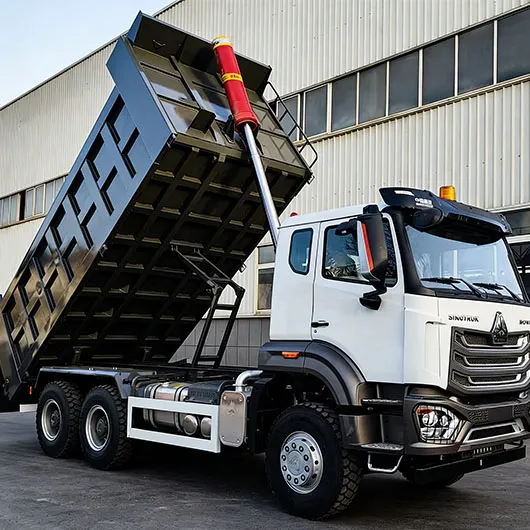
1.Walk or drive the haul road in wet conditions, not just dry season. A route that looks compacted in July can turn soft after rain — that’s the condition 6×6 is built for.
2.Check the grade percentage on the steepest section. Sustained grades above roughly 10-12% on loose surfaces are where all-wheel drive starts paying for itself.
3.Estimate annual tonnage per truck. If payload-per-trip drives your cost model more than terrain does, the 8×4’s higher legal payload usually wins on total cost.
4.Confirm whether the road will be graded and maintained, or left as-is. A maintained unpaved road rarely needs 6×6.
5.Request quotes for both configurations against your actual route description rather than assuming from a listing title — chassis and drivetrain specs are confirmed per build.
Pricing: Configuration-Dependent, Quote-Based
Neither the 8×4 nor the 6×6 has a fixed public price, because cost depends on chassis brand and platform, driven-axle count, reinforcement level, engine and emission tier, destination country, and shipping method, among other build variables. Buyers evaluating off-road-rated trucks should request a quote against a specific route and tonnage target rather than comparing listing prices across sites, since two trucks labeled “off-road” can differ substantially in what they’re actually built to handle.
Manufacturing quality on the reinforced-chassis side traces back to the ISO 9001:2008 quality management system certification held by the related manufacturing operation, though the certificate’s current validity and scope should be confirmed directly before it’s used as a standalone selling point in buyer-facing material.
FAQ
Q: Is a 6×6 dump truck always better off-road than an 8×4?
A: No. 6×6 helps most on soft or steep ungraded terrain. On a compacted but unpaved haul road, the reinforced 8×4 usually carries more payload at lower running cost.
Q: Does “off-road” mean the truck can’t also run on paved roads?
A: No. Off-road-rated and reinforced trucks can run on paved routes; the reinforcement simply means the chassis and suspension are built to also tolerate rough, unpaved surfaces without accelerated wear.
Q: Can ALL LIFECYCLE supply a true 6×6 dump truck, not just the reinforced 8×4?
A: 6×6 builds are available on a build-to-order basis for sites that genuinely need full-time all-wheel drive. Confirm terrain details when requesting a quote so the right drivetrain is specified.
Q: What’s the difference between a reinforced 8×4 and a standard 8×4?
A: The reinforcement refers to frame, suspension, and body upgrades intended for repeated rough-surface loading; exact component differences are confirmed per build at the quotation stage.
Obtenir un devis
Nous vous répondrons dans les 24 heures. En cas d'urgence, veuillez ajouter WhatsApp/WeChat : +86 17686600717. Ou appelez directement le +86 17686600717.
*Nous respectons votre confidentialité et toutes les informations sont protégées.
Nous n'utiliserons vos informations que pour répondre à votre demande et n'enverrons jamais de messages électroniques ou promotionnels non sollicités.